Tuesday, August 3, 2010

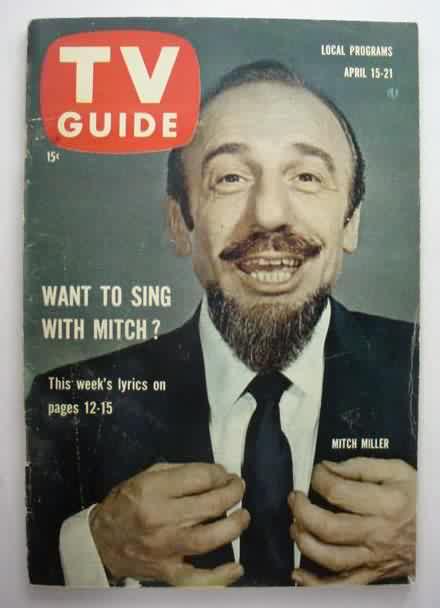
RIP Mitch Miller


Pawing through crates of dusty vinyl in all corners of the country, some records show up often, and are always worth passing over-- and Mitch Miller is responsible for most of them. He is always grinning, smiling as if he were In The Know, beckoning all of us to sing along, to sway to strains of melodies familiar and new. He had our grandparents and parents' eyes following the bouncing ball, shouting "Tzena Tzena Tzena," as the off-key notes were soaked up by the serenity and shag carpeting of the last century's living rooms. Upon his passing, the most appropriate tribute to Mitch Miller may be a full karaoke performance of Rod Stewart's 'American Songbook' album: some tedious and vapid participatory exercise for the ears.

But while his own successful brand (including many records and a television show) sold well, his work as Columbia Records' guru producer is what will go down in musical history. Mitch Miller was mostly responsible for a succession of lucrative, safe, 1950s crooners--Tony Bennett, Rosemary Clooney, Frankie Laine, and Johnny Mathis among them. As R & B morphed into rock and roll, and people like Bill Haley and Chuck Berry strummed their guitars increasingly faster, Mitch Miller carried on post-war big-band traditions, perhaps steering the course a bit to the mundane (one critic noted his "perverted brilliance"): think of non-rock-oldies from the 1950s, and it's likely Miller was at the helm of the project, conducting string arrangements through the slow pulse of old pop.

Not many people, in the music business or otherwise, could piss off Frank Sinatra and live to tell about it: Miller did, by making him sing sillier things than one would hear in modern nursery rhymes. Miller is probably why Tony Bennett recorded a highbrow jazz-vocalist album in collaboration with Bill Evans: to prove again that Not All Music is Background. The music was always slow and accessible, a less-ethnic version of Lawrence Welk, but with the same empty-headed happiness at heart: big band bemoans another ballad, and we all have something to which we can fall in and out of love, including the romantically-sustaining horns, the waltzy motion of another slow dance shuffle, or the bellowing of a chorus who, perhaps even in the recording studio, was all made to wear the same cardigan sweaters.

If there had been no Mitch Miller, there may have been less singing in the home in the world-- however contrived and unfamilar such an action may seem-- in the last century. And, had there been no "Sing Along With Mitch" vinyl, ever, perhaps blues would have become rock and roll (what Miller called "musical baby food") faster, or differently. In 1957, Paul Anka was singing "Oh, Diana," Buddy Holly was on American Bandstand, and the Quarrymen were playing their first gigs; Miller, charged by Columbia to pick up the tempo, produced the mildly exciting Marty Robbins hit "A White Sportcoat (and a Pink Carnation)." Sing along to that one!

If the mid-1970s musical GREASE, and its lasting popularity ("High School Musical," etc) means anything, perhaps it marks the moment pop music began to fold over upon itself: repetition of 1950s-style 'rock' riffs were more than permissible, they were encouraged, lucrative. In the 1980s, the synth played the same 1-4-5 progressions that Miller despised; by the 1990s, most pop music was as valid and as poignant as the Gilligan's Island theme song, or the schlock "Beauty School Dropout" from GREASE. By the time GREASE emerged as theater, movie and studio album, Miller's career in home entertainment was all but antique-- and the music that had taken his place was beginning to digest itself again. As much as he despised rock, Miller tried to negotiate a contract with Elvis Presley, but balked at what the Colonel wanted. If Sing-Along-With-GREASE would have made Miller money, he would have done it-- but by then the pop song had been relegated to its own slim genre, and Elvis was already a golden oldie. Miller outlived his medium and his message, and then lived for a long time afterward-- through a stint directing the London Symphony Orchestra in the 80s, through the entire life of Kurt Cobain, all the way to the rise of Lady Gaga, and all the neat sounds we pay for today.

Times are a-changing, though, including inside people's ears. New, soothingly vacant arrangements of standards-- Barry Manilow and Rod Stewart among them-- sell, about as well as anything else these days. Nothing resembles Mitch Miller's "sing along to this one with me" ethic, however. Forgiving his being the Rightful Father of Muzak briefly, Miller is responsible for having established through audio recording a weird kind of community: let's gather at my house and sing along to a record... it even came with a lyric sheet. Had rock and roll not taken the helm of pop, Miller may have been able to convince us to pay .99/download, for access to a bouncing-ball video, helping us remember the words to "Yellow Rose of Texas" and "Heart of My Heart."

Sunday, July 25, 2010

Flaming Lips at Mountain Park, 7/24/10

The Flaming Lips are still on tour, and, like all masters of their craft, they're constantly getting better at what they do: creating community through music. That's not necessarily the thesis that comes to mind during their opener, which still included the band's enterance through their own video screen, as they each emerged on stage from a psychedelic vagina. But as the confetti cannons showered all of us in colored tissue paper; as we kept aloft dozens of massive balloons (and larger balloons filled with small balloons, even), bouncing them off each other's heads; as we all listened and watched, between songs as Wayne Coyne, tireless frontman, sweating profusely, preached an unabashed positivism: we had our collective ears wrapped around some new unity that hadn't existed before.

Part of the fun of all this non-hokey community building was that none of us were really sure where we were. Mountain Park has been open as a concert venue for only a few months, just long enough for the Iron Horse Entertainment Group (also operators of the Calvin Theater, the Iron Horse Brewery, and a few other venues in the western Massachusetts corridor) to work out all the kinks: the pathways are new gravel, the parking lot lighting and roadways are new, the portapotties were clean and well-placed, and, admirably, the vendors didn't appear interested in gouging concert-goers ($1 water $4 fries $5 burger, and a Bud 16oz. aluminum for $7). Once a popular amusement park, the rides and coaster were removed in the late 1980s, and the land was recently purchased by the Iron Horse Group. I was surprised to not see any excavators or bulldozers parked in some corner of the gently-sloped clearing in the woods-- they must have just left-- because the place was close to perfect, in terms of terrain. The Flaming Lips was the largest show at Mountain Park so far: 3,500, with tickets still available at the door. If event organizers wanted to overcrowd this place like they do at Saratoga Performing Arts Center, there would have been 10,000 of us crawling all over the hill, scampering for blanket-space, failing to stretch out on the freshly-unrolled, deep green grass. As it was, we all had space; even if it had been crowded, the sound would have still been amazing. I haven't experienced many truly effective and enjoyable natural ampitheaters, but the placement of the stage was thoughtful, strategic, and well soundchecked.

Wayne Coyne of the Flaming Lips was disoriented in the schedules of the rest of the world, but ever-present in the moment of the show: at one point he mentioned to Steven Drozd their next two nights in New York City, but otherwise he was lost, mentioning twice how he hadn't realized it was Saturday night ("I thought it was Wednesday, or Tuesday, or something"), and appreciating the venue from his place of not-knowing ("I don't know where we are, but this is sure a nice place... whoever's doing this should keep it up").

The day of the week or the location of the venue is less important to the Flaming Lips, as their rock band philosophy continues to manifest in new musical and stage-antic ways: what is more important to Wayne, and the rest of the band, is the message, which is strategically intertwined with the music. At Bonnaroo, I saw them present a 70-minute set to precede their midnight cover of Dark Side of the Moon-- and they rollicked through the confetti, lights, and streamers, punching the crowd with immense bass riffs from their latest album, Embryonic. At Mountain Park, the setting of those new riffs-turned-songs from Embryonic helped support the music in a new way: a song whose main lyric is "when she smiles" (and not the Clouds Taste Metallic ballad) served as the opener, and I imagined Wayne was singing passionately about his wife, even as he climbed upon the shoulders of a man wearing a bear costume; a long, thoughtful song about dreams, though built around many, many gunshot-style paradiddles, was made all the more useful and important given Wayne's introductory pleading ("tell me this is not a dream!"); "See The Leaves" interrupted the mellow, singalong feeling of a section of the second set, being a song about "violence against violence," and featured crafty video montages of animals' teeth, open-jawed and poised for attack.

New material was not overshadowed by older and popular songs, and perhaps this is the Lips' finest achievement; for selfish reasons I don't believe they should remain, as they are in concert, completely ignorant of their masterwork, The Soft Bulletin. Some of the new material sounds like old stuff-- the chorus of the Lips pre-fame "Unconciously Screamin'," for example, may have fit as a bridge into most new jams. "Yoshimi Battles the Pink Robots" was the farthest reach back into their catalog; if one ancient song had fit the show, it would have been "Lightning Strikes the Postman." Once, I felt as though I was enduring the strange synth thunder found on the unreleased "The Captain," only to realize I was hearing more Embryonic material.

Some songs were played by a Zeppelin-worthy hard rock outfit; some songs sounded like an un-nervous Pink Floyd cover band who forgot half their gear (plainly, Steven commented to Wayne after a tremendously effective exploratory moment, "that was a nice psychedelic jam, Wayne"); some songs, strummed by Wayne alone and accompanied by Steven on keys/guitar/vocals, sounded more like a John Linnell-John Flansburgh duet than I had ever, ever expected from the Lips (most notably, "I Can Be A Frog"). Wayne was challenged to introduce "The Ya Ya Ya Song," a punchy anti-Bush cheer that, he tried to explain, has not outlived its usefulness.

Surely it has not, because "The Ya Ya Ya Song," as well as much of the newer material, only gave Steven Drozd a playground in which to frolick: a mad musical genius, I had been wowed by his multi-instrumental performance during two sets at Bonnaroo, but one could tell he had a Task At Hand. At Mountain Park, Steven warmed up, playing synthetic strings, electric pianos, and hammering away at his customized double-neck-turned-single-neck twelve string electric guitar. The talkbox became essential during "The Ya Ya Ya Song," and he began to have only more fun with it, singing along with all of his guitar notes. I've heard Trey, Zappa and others espouse the value of singing along with your instrument; I've never seen someone pursue that so accurately, vigorously, musically onstage. And besides, Steven may be taking singing lessons: if the song called for a high E, he shot for it, and seldom missed. Of course, who knows what electronic modifications may lie beneath the layers of road-sign-orange duct tape all over Steven's keyboard and pedal rigs-- but no amount of gear can replace such musicianship. The more harmonies he sang, the more I realized how Steven may be the 21st century's Brian Wilson: Smile.

"In the Morning of the Magicians" was one of the finest live Lips songs I've ever seen, and by far the best song at Mountain Park. This most majestic moment came two-thirds of the way through the evening, as Wayne exclaimed with pride the ability to give love ("to a tree, to an animal, to a person, to a piece of fuckin' food you cook"), you may know that love will always find you, "and so I will give you my love," he said, as he leaned over and gave as much of the crowd a hug as he could-- the first crowd hug I've ever seen. Steven sang all his critical guitar notes as well, and a pair of plastic shakers were critical percussion through the verses. Wayne sang "what is love and what is hate/the calculations error/is to love just a waste?," and the moon rose over the rolling hills of western Massachusetts, and the rain held off, and the video screen showed, in well-timed repitition, the face of a woman dancing in a 1960s esctacy, we were all made to fall in love with life again, with confetti and the crowd around us.

Wednesday, June 30, 2010

A Trip to Owl Farm

It was a bright morning in the midwest, and as the Rockies rose before me, and then rose around me, I drove past Woody Creek twice before I found the correct right turn: down into the canyon, off the wide divided highway to Aspen, and onto the Woody Creek main drag. Aspen has always sold its funky charm to its celebrities; never mind that it served Hunter S. Thompson as a home base since he purchased Owl Farm in the early 1960s. Never mind the center of Woody Creek is still a trailer park, a collection of surprisingly shoddy late 1970s metal boxes: one, next to the main drag, had a broken window and an unmowed lawn. Each trailer and lot is owned by the local ski company, to provide affordable housing for resort workers. Otherwise, the land is simply too valuable: "bet you've never seen a half-a-million dollar trailer," joked one of the locals.

Of course, the trailers in Woody Creek are the exception to the rule, as the Big Money can hide away where ever, in the hills beyond the town. Thompson always railed against "the greedheads;" that is, those capitalists for whom no amount of money may suffice. As private planes flew overhead Woody Creek hourly, writer and Thompson's neighbor Mike Cleverly described the day that Ken Lay's wife rolled up to his modest cabin, accompanied by Secret Service: the first news of the collapse of Enron had emerged, and Ken was in town to sell all FOUR of his homes in the Aspen area. Down the road from Thompson's beloved Owl Farm (he once called it his "lighthouse"), the Wiley brothers-- the pair responsible for the Swift-Boat ads that smeared John Kerry-- have a few homes, including one designed by a family member that looks both like a gnome home and fallen-down English cottage. I heard that she sat with an architect and molded the idea out of a lump of clay. To appease the locals, the Wileys donated $600,000 to the local animal shelter.

Other homes are owned by Kevin Costner, Michael Eisner, Kate Hudson, and Jack Nicholson, and others. Hanging out at the cafe and tavern in town, twice I was told that, in Aspen and Woody Creek, "the millionaires have moved out, and the billionaires have moved in."

On Thompson's road, the quiet is priceless: sprinklers sound a wet flutter over manicured lawns, and the squawk of animals rise sporadically from the hills behind the Thompson compound. Hunter's widow, Anita, played with a dog in the side yard; lining the fence that runs across the front of the yard, a woodpile continues to rot. Welded vultures still adorn the gateposts; a welded bat stands on a pole outside the two large picture windows in the front corner of the house.

In town, the Woody Creek Tavern doesn't mention Thompson explicitly, anywhere: photographs, notes, paintings, and years of memories adorn the walls. I met a guy who delivered booze weekly to Owl Farm from Aspen, driving a case of 1.5L Chivas Regal bottles, a case of Groschl flip-top bottles and a case of 1.5L bottles of red wine, "for his secretary.?

February 2005 was an especially dark time in America; though the economy had not yet collapsed, the "greedheads" had already long taken control. Thompson chose to stare down the barrel of a shotgun over enduring Bush's second term; like Plato's "Crito," Thompson had come to abhor the political and social system he had helped to create. On that night, Hunter and his wife had had a fight; she was elsewhere, likely in town; he had been walking with a cane as well, after health problems made him weak. Mike Cleverly wouldn't confirm that Hunter had typed "COUNSELOR" on a lone sheet of paper in his typewriter. Cleverly's own collection of Thompson stories-- The Kitchen Readings-- is available on Amazon; as Hunter's neighbor and friend, he chose his words and stories of Thompson carefully. The definitive biography of Hunter, he said, is being written by Douglas Brinkley, who accepted no pay for his extensive editorial work on two volumes of Thompson's letters.

I passed Cleverly a card with my website address on it, and he chuckled: there is no high-speed internet on his road. "Thompson never had DSL?" "Hunter never had a computer. They'd keep sending them," Cleverly said, "and he'd use them, and then a day later they'd be in the trash." It's important to know that, for all his Gonzo travels, Hunter never surfed the web from his kitchen, never explored the internet from home.

I drove through Aspen ("don't deny yourself," Cleverly told me), leaving behind a dream of Woody Creek, Colorado: Hunter wasn't home, and his widow took no interest in me, holding up a copy of her latest book, "The Gonzo Way," hoping for an autograph. The sun shone across the arid landscape; the sprinklers kept the wealthy lawns wet, and growing.

Thursday, June 24, 2010

Phish: the Tweezer Shows, 6/18 and 6/19/10

After the second night of Phish's two-night run in Hartford, and the first overcrowded night in the boys' home turf, SPAC, it's safe to assume that one of Vermont's most profitable exports has regained their stature, stage presence and groove: for better or for worse. Before SPAC, I hadn't seen Trey stand dramatically on the stage monitors since the pharmaceutical antics at Coventry in 2004; though a friend and noted Phishtorian declared that she believed "Trey's on something," during a snoozertune at SPAC, there were few other hints that any personal reckless may endanger the Weekapaug Grooves: a missed lick in the first measures of "Reba" and some strange modulation in "Tweezer" can be forgiven-- though not all summer. I think Trey's clean, and substantially more relaxed than during last summer, when they were busy at Fenway, MSG, etc., reopening the tie-dyed scar on the music scene that is Phish.

These were two, outdoor summer shows, and because they're now overcrowding the lawn at SPAC to New-York-City-rush-hour-bus-station levels, the Hartford show was better. Someone in the lot told me that the "Fee" that began the second night at Hartford was "the greatest 'Fee' of all time." It was about as righteous as any "Fee" I've ever heard... as was the "Wolfman's Brother," which led to a righteous jam, which is not to be confused with the ascending-to-high-dweedle-dweedle-dee-guitar notes jams that followed a pedestrian tempo "Julius," a wedding-band "Billy Breathes," and, at SPAC, "Bathtub Gin" and "Free."

There's an obvious fear among the band that they'll sound TOO much like Phish. Though each live show this summer will likely roll out a prescription's worth of entracing, headbobbing riffs, the boys are trying to find new musical space in which to play. Hopefully it's obvious to them that their new live diatribe riffs won't be found among the chords of Trey's new low-grade ballad "Summer of '89," or of Page's forgettable number from SPAC. To Trey's credit, the lyrics of this much-panned song may be the most earnest, and heartfelt that I've ever heard from the frontman, and if it didn't suck, I'd love to hear it again.

These two shows helped me understand more why I still like Phish. As I shuffled slowly, along with thousands of others, leaving the venue in Saratoga, I realized I'd trade all my Phish adventures to come, for the chance to wear headphones during every show: magical headphones that let me hear exactly, and only, what Mike Gordon is doing to hold the band together, to keep the jam flowing, to push the groove. In Limestone, Maine I bought a long-lost sticker that still applies: OBEY MIKE. This advice is especially useful to the other members of the band these days, and the double-Gordo slam at Hartford ("Foam"-->"Possum") proved why the electric bass is the great motivator: "Foam" (like "Rift," earlier in the set at Hartford) seemed fast enough to be constantly on the verge of implosion. Trey played one of his finest (and original!) solos during the country-fried "Possum," and the whole place bounced along wonderfully. Mike's finest moment may have come during "Harry Hood," when he invented a groove that somehow ate up an eighth note, or some division of time the boys are far more familiar with than I: it was not a miraculous musical act, but a feat that they performed beautifully, smoothly, without hesitation, a brigade through the jam section of "Harry Hood" led by the man slappin' away at the bass. I was at the portapotties as the second set at Hartford began: "hurry up," yelled a guy with a beer to the people in line, "Mike's coming back on!"

As Trey pursued Mark Knopfler-type licks in among "Sleeping Monkey," and as Fish whisper-sang a verse in "Moma Dance," I wondered if Page's piano teacher was in the audience at SPAC. Set two opened with the Velvet Underground's "Rock and Roll," and rarely exceeded a Lou-Reed-tempo-speed-limit. Trying to rally the troops after another new snoozer "Halfway 'Round the Moon," "Prince Caspian" was no faster than the previous night's "Wading in the Velvet Sea," and thus twice as dull. During the "Squirming Coil" piano solo, Page played well-- not well enough for my neighbors on the lawn at SPAC, who spoke with disgust, as they described how they had seen Page leave his SUV running, with air conditioning running full-blast, when he runs into the Starbucks in Winooski.

The internet is helping shape musical tastes, from the ground up, and while I don't endorse passing judgment on performers' personal choices--especially during their performance-- I can't help but to take into account why a band is performing when I see them. Explaining why the crowd was to be treated to a second "Tweezer Reprise" at Hartford (ran out of time in Hershey, PA), Trey joked that Phish was "the all-request band." Spreading the good vibes a few hours north, they kicked off-- and closed up-- the first night at SPAC with the same rising-chord anthem. Caught up in the silliness of it all--the special, crowdpleasing silliness of four versions of the same song in 24 hours-- I found myself in the floodlights at SPAC after the show, and I started yelling "All Tweezer! All summer! Nothing but Reprise!" I hope, in coming weeks, the "all-request" manifestation of Phish 3.0 takes old material (I appreciated the NEW complexities in "David Bowie!") and continues to seek that new and elusive space in the musical strata. For two nights in New England, it was "Tweezer Reprise" that took us all there.

Friday, June 18, 2010

Bonnaroo!

Now entering its tenth anniversary, the Bonnaroo Music and Arts Festival might finally be worth the trip, especially for those of us who travel extensively in small circles of New England venues. After this year’s exhaustive and comprehensive lineup, Bonnaroo is now established as America’s answer to large European festivals like Glastonbury and midwest gatherings like Wakarusa. Bonnaroo, tweaked and primed after nine years in the business, presents a tidy live music machine for the masses, a discreet and collapsible city that turns mad profit within a week. Because it’s gotten so huge, Bonnaroo provides a forum for two groups: those needing to dance maniacally for days on end, sleeplessly stumbling from stage to stage, and those seeking to fill a massive live-music-festival fix, without burning away to a crisp.

Bonnaroo lives up to its claims of musical variety: this year’s headliners included Jay Z, Stevie Wonder, Kings of Leon and the Dave Matthews Band, while elsewhere the crowd raged electronically to LCD Soundsystem, The Crystal Method, DJ Logic, Daryl Hall & Chromeo. Elsewhere, Kris Kristofferson, the Nitty Gritty Dirt Band, Steve Martin’s triumphant return to the banjo, and John Prine represented the country and western idiom; Weezer, Ween, the Black Keys, Clutch, Tenacious D, John Fogerty, and Jack White’s new band, The Dead Weather played raucous, expectable rock riffs and shtick. Modern rock saint Jack White looks and acts more like Lou Reed every day, and his new band is fronted by a Janis Joplin-lookalike, who sang lines from Jim Morrison’s notebooks, over chords that sounded like King Crimson outtakes. No wonder it was the only time it rained all weekend.

Or maybe it rained because, a few stages away, the bass was so loud during the Avett Brothers that it shook water free from the clouds. While the live sound engineer finally got it right between “Head Full of Doubt/Road Full of Promises” and “When I Drink,” a staggeringly honest duet, the Avett Brothers, for all of their country-rock crossover appeal, proved musicality, and sheer energy will always triumph. Showing off new levels of musical prowess, the Avetts (and friend Dave Mayfield, “of the Mayfield family”) switched instruments often, and enjoyably; most songs held in their core a furiously-strummed banjo line, and the crowd bobbed appropriately. “The Perfect Space,” a song from their recent collaboration with Rick Rubin, featured electric guitar, piano, bass, and perfectly rambunctious drums. The crowd of sunburnt, rain-washed, youthful fans swayed and sang, and were especially loud with the lyric: “I wanna have pride like my mother has/and not like the kind in the Bible that turns you bad.” Other acts wallowed in black-clad gloom, while the Avetts literally rocked the crowd into backwoods stomping, head-swinging madness and southern yelps.

The other most-resonant lyric I picked up on came as John Prine played to a surprisingly-ecstatic and youthful crowd, picking away at “Blow Up Your TV”; this generation, too, it seems, wants to “plant a little garden/eat a lot of peaches/we’ll all find Jesus/on our own.” Complemented by authentic outfits like the Carolina Chocolate Drops and Dr. Dog, all of whom strum like G Love and wail like Merle Haggard, Bonnaroo’s lineup helped further and galvanize the growing 21st century live roots music movement: a new stand-up bass brand of authentic American roots music continued to take shape over the weekend, without direct appeal to mainstream country or top 40 “rock.”

My largest critique comes from Bonnaroo being less than seventy miles from Nashville, and the engineers seemed least adept at amplifying traditional bluegrass: after horrible feedback interrupted the fiddle player’s solo during Steve Martin’s bluegrass opener, he smiled and joked to the crowd, “how’dya like that high-pitched squeal?” Often, stages competed with each other for volume, as perhaps festival organizers planned to pump the bass on everything, always giving the teenyboppers something to rattle their bones with: Multiple-Grammy winner John McEuen, the Nitty Gritty Dirt Band’s legendary banjo and guitar picker, joked that he had just written a song on the banjo, to be played when there’s a rock band booming next door. He grinned and grimaced as he picked, perhaps the only legend on par with Stevie Wonder throughout the weekend, having been an integral influence for decades, in many genres. As he riffed inside of the Dirt Band’s tight drums and keys, the crowd went nuts: “I’m going to play the banjo in Tennessee now, which is something I like,” he laughed.

Especially tender musical moments could be found on the small Solar Stage, where my festival favorite, Diane Birch, played alone on an electric piano, describing how her Pentecostal upbringing had merged with her Suzuki/by-ear piano technique, to produce her recent debut, Bible Belt. She looked like an angel, played piano riffs in the style of Elton John and Ben Folds, and sang jazzy alto lines about love and God and “Hallelujah/I got water, I got air/I got flowers in my hair.” Located in Planet Roo, a gathering booths and tents featuring socially-conscious organizations like The Mountain Coalition, Greenpeace and Ford, The Solar Stage featured short interviews and acoustic performances by larger acts as well—not to mention phenomenal African drumming by Mawre and Company, a father-mother-son-daughter team who led the crowd astumbling through dance steps, on all three nights of the festival.

Electronica, however, ruled the day, and the nights were injected constantly by the bass thumps of distant raves over the hill-- like it or not. The most notable of this late-night ilk was the far-out noise produced by Dan Deacon’s 14-piece ensemble. The soundcheck was extensive: live drums, two synthesizer stations, three marimba/percussion players, guitars, and, teetering between mixers, headphones, and a glowing skull, the essential instrument, Dan Deacon himself. He spoke to the house engineers and the crowd in the same insistent manner—do what I say, that we may go on with this. The result of the efforts sounded like tracks by the early Philip Glass Ensemble, adding in Deacon’s thin, crispy vocals, that usually rose through a song, above and against the revolutionary arpeggios of the marimbas, usually ending in a full-out rock scream. Though gaining a reputation for audience participation and a sense of humor, I was excited to find an autographed copy of the sheet music the band used at their Bonnaroo show, donated to a charity’s silent auction taking place on the grounds. There’s only one other artist wrote sheet music and threw dance contests during performances (Zappa), so I’m excited to see what Dan Deacon gets good at doing next.

The XX, Crystal Method, LCD Soundsystem kept the main grounds thumping into the wee Tennessee hours of morning, always in competition for attention with the trance of the all-night DJs. There was some rock at night—the Disco Biscuits did their thing, and GWAR ridiculed Margaret Cho at 5 AM on Sunday morning, spraying the audience with fake blood. Deadmau5, a DJ who mentions champagne and Red Bull on his Twitter feed, and whose gimmick is to wear a giant mouse head while spinning, was especially popular—enough to be the site of the only death at Bonnaroo this year. The fellow had been camped a few tents over from mine, and had been taken to the medical tent during the early-Sunday-morning performance, running a temperature of 108. By 3 AM he was pronounced dead at the hospital. Buzz in the lot said he had taken ecstasy and molly, a pure form of the compound MDMA. Those of us who had camped around him—friends now, all of us having braved the long days’ heat and short nights together—remembered him as best we could, another t-shirted kid with a Shakedown St. sticker across the tinted back window of his Honda, another body pushing forward; we had all been pushing toward the same stage hours before.

As the sun went down on Sunday evening, and our tents grew shadows and became silhouettes together for the last time in the Tennessee heat, I spoke with Coffee County Deputy Sheriff Frank Watkins, as his team gathered the dead fellow’s tent and belongings and stowed them in the Honda. Frank was a tall man in a gray t-shirt, and he spoke in a patient, sober, southern drawl. “I don’t mean to brag,” he said, as he stared into the distance, “but the meth we recover in this county is between 95 and 99 percent pure.” He admitted that his agency’s primary focus is to target those selling hard drugs—heroin, opium, crack, ecstasy—and that “if all it was was pot, I’d open a corn dog stand.” During their set of original music, to precede their epic live cover of Pink Floyd’s Dark Side of the Moon, Wayne Coyne—patron saint and longtime veteran of Bonnaroo—challenged the crowd to work to legalize marijuana over the next year: twice, between firing off confetti rockets and orchestrated psychedelic video montages, Wayne called to the audience, saying “I thought I’d smell more pot smoke at a Flaming Lips show.”

From-the-stage activism was slim: some graffiti sought to blame different modern presidents for the encroaching oil slick, while few artists took sides on much of anything (“there’s no oil spill here,” one performer noted). Baba Maal, a Senegalese bandleader whose ensemble provided some of the finest, most-even tempered music on Sunday morning, called for peace between UK and US World Cup fans, asking that we support “the best team on the ground.” In this economy, performers are wise to not alienate fans with politics; for espousing challenges to the status quo of drug prohibition, from the stage and from the event’s commemorative t-shirt (“be a nice person/legalize marijuana”), the Flaming Lips once again rise to a new level of greatness—no matter that Wayne’s calls for legalization caught the crowd at a moment when they were too zonked to agree.

In a different era, the average demographic at Bonnaroo would have appeared on Dick Clark’s American Bandstand; the group of six friends from Connecticut camped beside me had to leave on Sunday morning—to miss Dave Matthews’ lovely solo encore opener, Neil Young’s “Needle and the Damage Done”—so they could return home to graduate from high school. On Sunday night in the main concert area (“Centeroo”), there were still plenty of wide-eyed, suntanned southerners standing shoulder-to-shoulder with legions of frat boys, who had chugged seven-dollar beers all weekend, and yelled loudly to each other when their favorite songs came on. The dredlocked hippie type, both of my generation and the about-to-retire one, pocked the crowd with tie-dye, dredlocks and electrified glowsticks and flashing light sabers. We all wore shorts; we all gathered under trees, for the chance to be a few degrees cooler in the shade; we all rejoiced, however briefly, when the sun ducked behind passing clouds in the southern sky. Many took naps on the ground at some point; late at night, safety team members roamed the concert areas between acts, prodding us awake.

Bonnaroo is one day longer, and offers four times as many acts, as the original Woodstock festival in 1969. Only the crowd is smaller, one third the size—but you wouldn’t know it. There’s enough to keep over 80,000 people entertained, and not in one place at one time: besides one mammoth stage for evening headliners, there were four airplane-hangar-sized tent stages, a smaller Lunar Stage that, this year, featured the aforementioned eternal and inescapable dance music.

The spiritual connection to live music may be strengthening, and the tide of respect for performance may be growing—I met a rep from Sony Music whose sole task is “grassroots, bottom-up, hands-on marketing campaigns.” Most folks I talked with claimed to be in a band, though I’ve seen more parking-lot performance at a Phish show lot than I did this year at Bonnaroo. I heard someone appreciate how Jay Z actually performed with a band this year, and not just to some backing tracks. He hyped the crowd up before his appearance, using a ten minute countdown and a playlist that pandered to the crowd’s shallow roots: Notorious B.I.G., Nirvana’s “Smells Like Teen Spirit” and the Beastie Boys’ “No Sleep Til Brooklyn.”

The most universally-accepted moment at Bonnaroo this year may have been Jeff Beck, and his majestic cover of “Somewhere Over the Rainbow.” Without gimmick or effect, Mr. Beck made each note count, in a way that wasn’t always apparent at Bonnaroo: arpeggios, whether from a banjo, Akai MPC sequencer, or within the Flaming Lips’ complex presentation of Dark Side of the Moon.

If Bonnaroo 2010 had a patron saint, it was Wayne Coyne of the Flaming Lips. During the Friday afternoon press conference, he rambled prophetically about the purpose of the event: not the individual bands, but to be a part of a triumphant and beautiful experience: to be “here with your friends having one of the great experiences of your young life.” Surprisingly, as Wayne himself called for a ‘short’ opening set of Flaming Lips music to precede Dark Side, the Lips relished in recent originals—nothing earlier than a few tracks from Yoshimi. I spoke with Wayne, and thanked him for the vinyl re-release of their 1990s epic The Soft Bulletin; he spoke nervously about the night’s impending live cover of Dark Side: “I hope it’s not too weird,” he said.

It wasn’t, and neither were the giant inflated balloons containing dollar bills that Wayne threw into the crowd during the Pink Floyd classic rock staple “Money.” As the balloons bounced around, as Wayne himself had done, inside a giant plastic ball to open the show, each eventually popped, showering the crowd with something there was plenty of at Bonnaroo: cash. There were no riots, no trampling; in this economy, I was proud to see how long each balloon stayed aloft, and wondered what Wayne expected to happen. Musically, the Lips, alongside Wayne’s nephew’s band, all under the extreme direction of Steven Drozd, delivered a magical rendition of the Pink Floyd masterwork, replete with themed video sequences, pre-recorded “I’m mad/I’ve always been mad” babble, and a heartbeat that resonates with me now. The performance ended with all the flair, smoke, mirrors and lasers of the greatest stadium rock performances, and we were suddenly thrust into an eerie dark. The houselights rose on us (“all that we eat/everyone we meet” still ringing in my ears), and, quietly, a graceful, less-than-good quality digital copy of “What a Wonderful World,” by Louie Armstrong, began to play.

The Lips, and so many others at Bonnaroo, knew so well what they were doing to entertain an audience; on Sunday afternoon, after so many bedraggled hours in the sun, Ween could not have chosen a better motivating cover than David Bowie’s “Let’s Dance.” Like life, there’s too much to see at Bonnaroo, too much entertainment in general—which makes it worth the expense, the hassle, the unexpected adventure of it all.

Thursday, June 3, 2010

Bonnaroo Vs. The Point

There's been some major construction taking place where I live, so The Point (pointfm.com) has been playing constantly through my clock radio, and they've been subliminally prepping my ears for Bonnaroo: I'm ready for chainsaws, power drills and buzzsaws, as Dave Matthews strums strange rythyms and sings about teaching kids to fly, and the Kings of Leon kick up John Mellencamp riffs, into 21st century power pop. In less time than it took to replace a section of roof on this cabin, the whole tent city will rise and fall, and all of us-- Conan O'Brien, Jay-Z and Stevie Wonder included-- will make our way to some wide, flat place, and bob heads together. As for The Point is amazing, for being an independent radio network. I give them credit for being reasonable, interesting, and willing-- and for giving away as many tickets as they can. For that reason they get a pass, for riding too closely to the Natalie Merchant-Stevie Nicks-Melissa Etheridge playlist. Usually they're in competition with my Sirius stream... but local radio will always have its place. Yesterday's interview with Grace Potter was excellent, and worth breaking up the morning drive-time playlist (I learned that Goddard's Haybarn was the alleged site of Black Sabbath's first American performance?). Live performance, though you can't turn it off, like a contractor's chainsaw, will always have its place, some temporary and reconstructive din. One of the best parts of Phish fests was the live radio station: being able to tune in and drop out for a few in the car, melding the two media together. Though we'll all be camped in a field at Bonnaroo, overloading cell phone data networks trying to stream digital information that relates to our lives, I'll always be glad to wake up to a clock radio. When I was a kid, WCZN 1590 AM, Your Country Cousin; for now, it's The Point, as I gather my granola bars, and stuff some Nag Champa in with my sleeping bag.

Thursday, May 27, 2010

Bonnaroo Press Conference 5/26/10

Nathan Followill, the Tennesee native, Bonnaroo veteran and King of Leon had a bad cell phone connection for about half an hour. He talked the way you would expect a rock star to talk: BILLBOARD asked what the new album would be like, and he answered (in the style of Steely Dan, circa 1972), 'uh, y'know, it was our first time recording in New York, which was a big experience... I mean, it's not LA...' Followill, between dropped calls, described their new album as fresh, neat, appealing, hip. He coined the term "hippiesters," in discussing how Bonnaroo has changed: later in the call, with pop god Dave Matthews on the line, Followill also used a phrase I had yet to hear: "ex-in' his balls off," referring to someone he saw at Bonnaroo, who's been stumbling around on esctacy for days. The guy was merrily getting arrested by a cop, a rare occurance, Followill was eager to note.

Dave Matthews wrote some of the first music I spent money on; about five years after that, I stopped paying attention to Dave. In college, I spun his Live At Red Rocks album incessantly; from the song "Everyday" onwards, I stopped paying close attention to Dave. I have never seen him live. I was lucky to be a pimpled, awkward kid in high school when "Crash (Into Me)" came out. I used to be fascinated by his sense of beat and vocal phrasing and instrumentation... but, as it became more familiar, it became less unique.

So, Dave Matthews Band is taking next year off, and I'm absolutely thrilled. In this press conference, Dave was quick to point out that next year's hiatus is exactly that; after a few probing questions, he admitted a hiatus three years prior would have meant something different for the band. He described his confidence in taking a year, "to get the creative juices flowing." Later, he trailed off, in a sentence that sounded like Michael Scott from The Office: 'I'll do any... thing in the world that... gets a... new creative idea... into my head!' Dave Matthews also admitted to putting on a hat and sunglasses, and walking around at Bonnaroo in the past, though his tour schedule doesn't allow for that now. In spewing verbage over prior infighting among band members, Dave admitted that the DMB has always had the crutch of "being that band on tour," that band I spun back in high school. Without the famed "pressure of the road," I'm very excited for Dave. Perhaps he'll write a quaint rock opera, or bluegrass, or something.

Dave's best Bonnaroo moment is also now my favorite Bonnaroo story, thus far: Dave crossed paths with Bob Dylan backstage, Bob told Dave, "I didn't play Watchtower because I figured you would."

Sunday, May 23, 2010

Nitty Gritty Dirt Band, Barre Opera House, 3/24/10

March 24 2010
Barre Opera House, Barre, Vermont
On a blustery Wednesday night in March at the Barre Opera House, the Nitty Gritty Dirt Band [NGDB] exceeded every expectation. Through two extensive sets, Jeff Hanna, John McEuen, Bob Carpenter and Jimmie Fadden displayed technical agility and musical passion. Beyond renditions of their hits “Fishin’ in the Dark” and “Mr. Bojangles,” NGDB used acoustic instruments—harmonica, mandolin, banjo, and different electric guitars among them—to survey American “roots” music, from Appalachian banjo-stomp rags to folksy ballads that could belong on modern Springsteen records, or could be covered by Norah Jones. At their worst, the synthetic tones from the keys got in the way—nearly mocked— the diligence of the guitars, banjo, and dutiful percussion, leaving some original material to resemble modern country balladeering. At their best, however, after forty-two years of playing together and a number of Grammys between them, NGDB showed the windswept Vermont audience their roots: contemporaries of different generations of musicians, across a spectrum of pop, rock and country. When NGDB was at their best, they showed that they are masters of their craft, and sounded like things to come: accessible mountain music for the masses, simplicity to inspire foot stomping and smiles.
NGDB started in 1966 in Long Beach, California as a jug band, in the same year Bob Dylan went electric and was booed offstage in London, the Grateful Dead played their first concerts in San Francisco, and the Beach Boys released their epic Pet Sounds. Country music in 1966 was fragmented, between contemporary songwriters like Johnny Cash, Merle Haggard and Willie Nelson, and a troupe of Grand Ole Opry mainstays dating back to the 1930s, including pickers and players like Roy Acuff, Doc Watson and Jimmy Martin.
After releasing a few commercially-unsuccessful hippie-country records, NGDB sought to unify generations of musicians in 1972, when they invited a host of Grand Ole Opry artists to a studio in Nashville. Over six days, Will The Circle Be Unbroken was recorded: a collection of live in-studio performances that successfully—to a triple-platinum extent—sold old time pickin’ to the both the hip rock populous, the folksingers, and the squares. In my family, where tastes run wildly incongruent, Will the Circle Be Unbroken is universally accepted to be “good music.” Some of the songs by A.P. Carter (“Keep On the Sunny Side” and “You Are My Flower” among them) will resonate forever in my history and my heart. It is a blessing that the Nitty Gritty Dirt Band is still intact, touring, and as proficient and as influential as ever.
At the Barre Opera House, Jeff Hanna, founding member, played a variety of electric and acoustic guitars, including a remarkable, black Gibson SG, through a wild-looking custom amplifier, and sang lead vocals on most songs. His electric guitars sounded like rockabilly, as though they belonged on a Roy Orbison record; his brash, percussive strumming on the acoustic reminded me of too-familiar John Mellencamp riffs. Bob Carpenter played three keyboards, including the bass line for all songs. He sang from behind his keys, except to sing Hanna’s original song “Bless the Broken Road,” which won a Grammy for Best Country Song in 2005, when covered by Rascal Flatts.
NGDB benefits from two talented multi-instrumentalists. Jimmie Fadden began the show from behind a unique drum kit: six giant cymbals and two resonant toms that he seldom played, a snare, kick drum, and hi hat. He kept a steady country beat flowing through most songs using his feet; he played harmonica, beautifully, accurately, adding organ-like drone tones behind guitar and banjo strumming. In a purple headband to keep the harmonica microphone in place, Fadden was full of life, happy to be playing. During the second set, he performed alone, singing a traditional blues about a train, accompanying himself, and wailing, on the harmonica.
John McEuen played the mandolin, fiddle, lap steel guitar, acoustic guitar and five-string banjo; he played the banjo most, and best. Later in the show, I realized how much McEuen needs a few songs onstage to ‘warm up.’ He reminded me of Mark Knopfler, another axman who, when I saw him in Edinburgh, seemed to need the first third of the concert to get in the groove. McEuen came alive during the fourth song, picking up the banjo and appearing unable to put it down.
It’s worth noting, too, that McEuen is as much a producer as a player, having recently won a Grammy for his production of his high school friend Steve Martin’s return to the banjo, The Crow. During the second set, McEuen played a detuned guitar, and, not unlike his friend Steve Martin, told some fine jokes in between riffs. His back arched, his knees bent, McEuen stood facing the audience at one point and, in the middle of a gentle riff, hit the low, open string and got a surprising amount of tone—and he laughed, enjoying himself immensely. McEuen played with a concentration and technical accuracy that reminded me of Leo Kottke; like Leo, he became wonderfully merzmerized, almost entranced by the sound of his own playing, letting new notes fly into bluegrass progressions. As he played a piece written for use in a film, McEuen showed that he is truly a master of his craft.
NGDB chose their cover songs strategically, reflecting their long history in modern music. Beyond original material, the first set included songs by Willie Nelson, Jimmy Martin, an uptempo version of the Grateful Dead’s “Dark Hollow,” a rockabilly version of the Beatles’ “Get Back,” and a slick blues take on Canned Heat’s anthem “Goin’ Up the Country.” During the second set, Jeff Hanna introduced Jerry Jeff Walker’s “Mr. Bojangles” as “a song that changed our lives,” and urged the full house to sing the final choruses. Hanna donned a white Stratocaster for the encore: “Will the Circle Be Unbroken” into the odd, but decent classic rock staple “The Weight.” Interestingly, the latest NGDB release—The Speed of Life—includes ripping covers of Steelers’ Wheel “Stuck in the Middle (With You)” and “Goin’ Up The Country.” This summer, NGDB will perform at the Bonaroo Music and Arts Festival in Tennessee, sharing the bill with the Avett Brothers, Norah Jones, the Carolina Chocolate Drops and Steve Martin, among many others. As American pop music continues to evolve, the Nitty Gritty Dirt Band will become legendary, with every fresh banjo riff, every harmonica wail, and every American tune.

Thursday, September 24, 2009

Quincy Jones' "I Heard That!"


How does a producer mix different instruments together? I'm listening to Quincy Jones' "I Heard That!" album, and am thinking of a famous advertisement: Quincy standing on the back side of a mixing board, resting each elbow on an Auratone SuperSoundCube 5C. These are legendary and awful speakers, almost built to sound like a car stereo or other consumer product. They're just one 4"(?) speaker in a sealed enclosure. When used in the studio, Auratones provide a reference for like nothing else. How this happens is a wonderful mystery I'm not out to discover. I do hear-- on tracks like "Never Gonna Lose This Heaven"-- a wonderfully sparse soundscape. The drums are mild, paced, and sound present in only the highest highs. The bass drives, but does not grumble, the band through progressions, and all else is gloss: horns and horn pops, smooth vocals built of plate verb and sultry women, flutes, and the quietest vibes imaginable. Each track reminds me of Deodato, the keyboard master of the classic-rock-variation-opus. Nothing on this Quincy Jones record feels as inspired, or at least reverent: I could have a party to these riffs, as the synth solos give way to guitar, and the guitar gives way to a vocal tag line or harmonica whirling. Deodato's second album is as spiritual as a prayer service; his version of "Rhapsody in Blue" is transformative.
There's something poetic about these huge mixes-- horn charts, smooth vocal yelling, drum fills and so many fragments of jazz besides-- being piped into perhaps small, effective studio speakers to get mixed together. Perhaps our ears (and our senses?) are simpler than we let ourselves believe.

Wednesday, September 23, 2009

"Sad And Deep As You"

I first heard the psuedo-Traffic concert "Welcome to the Canteen" on cassette tape, taken from my dad's collection when I was in high school, because I recognized Steve Winwood's name from the Blind Faith album. In high school, I was taken by the interplay between a conga player named Reebop and a rock ensemble-- and, was taken by Steve Winwood's incredible sensibilities when he plays the keys. In high school, I jammed along to the 12-minute version of "Gimme Some Lovin'," an ultimate Oldies radio cut, as it was turned into a funky improvised classic rock jam, years later to be adopted by the Dead themselves.
There is something eerie and empty about "Welcome to the Canteen," and not just for its literally-spacious recording: the hall is huge, and the natural echo on the vocals may be the most entrancing quality of this album. The vinyl plugs both long tracks-- "Dear Mister Fantasy" and "Gimme Some Lovin'" onto side two, leaving the handful of Winwood/Traffic tunes on side one to stand alone. I know the tape sequenced it differently; the vinyl arranges side one to be its own emotional trip, indeed. Winwood's mournful lyrics ring in the hall with a similar emptiness, and the expressive band is forever urged, pushed forward, by the piercing, dynamic congas: "Forty Thousand Headmen" is quite an example of this. The show opens with "Medicated Goo" in a rollicking tone, reminding me of the opening track on so many Steely Dan albums ("Black Friday" included).
The song that really rang true this morning was "Sad And Deep As You," a love song with few words. The movement of the guitar to contrast the slap-happy-sad feel of the percussion, lips that tell a story/sad and deep as you... the house filled with forty-year-old echoes as the sun came up and lit up more leaves that had turned more colors in the night. Like slaps of the conga, they fell as I listened.

Tuesday, September 22, 2009

An Introduction

Welcome to Common Time Vermont! This blog will celebrate music in all its forms: live, recorded and spontaneous. I drive a lot, giving me the chance to listen to new music on Sirius, or choice CDs. I wake up every morning to a new slice of vinyl: this morning was Guy Clark's album about Texas. As the sun poured across this cabin this morning, the pedal steel echoed against the brick chimney, and the mild swing beat lulled me into morning. Outside, the leaves transform the hills these days, painting them each with a brush of orange, gold and brown tints, until each hill has gone bald with winter, and the leaves are driven underground by snow. Guy Clark sang of the coast of Texas as the sun rose, to burn off the chill of an autumn morning in Vermont.

Saturday, April 19, 2008

Pedagogy, Art, and the Language Arts

This work was produced in conjunction with Union Institute and University's Masters of Education program at Vermont College. 

The Intersection of Pedagogy in Art and the Language Arts

The aim of art education in the public schools is not to make more professional artists but to teach people to live happier, fuller lives; to extract more out of their experience, whatever that experience may be.

  --Grant Wood, “Art in the Daily Life of the Child” (as cited by Decker, 2001).

            The practice and pedagogy in action in the secondary language arts classroom may become better informed by the examination and utilization of some modern methods and rationale at work in art education. As the value of visual and performing arts curriculum in public schools became contested during the 1980s and 1990s, many new rationale, as well as a trove of methods implementing ‘arts across the curriculum’ were developed. The secondary language arts classroom in the American public school deserves, and is in need of, a similar debate: some forms of communication at work in the world today may be expressive, containing emotion, meaning, and power, and expression can still be an art, and may still help students, in the words of Grant Wood, “extract more out of their experience.”
Drawing from Eliot Eisner’s 2002 Arts and the Creation of Mind, John Dewey’s Art as Experience (2005), and Dennis Atkinson’s Art in Education: Identity and Practice (2003), this paper will review common pedagogies, in theory and in practice, at work in arts curriculum, and will provide suggestions for a new approach for educators in the  language arts classroom.
            Art education pedagogy regards the importance of art education to both the individual and the wider community. This difference in the language arts classroom could manifest in whether or not the student’s writing assignment will be handed in to the teacher for assessment; it is important to note that language arts, and creative writing, can offer students a classroom opportunity to express themselves privately. Art education, especially the facilitation of students’ production of visual art, may offer less privacy, as often students in an arts classroom can view each other’s methods and products as they are created. This distinction of classroom environment is an important one: that a student’s painting, pottery, or sculpture is automatically shared with the class, and that is not a condition of the language arts classroom. 
As well, a student’s participation in a language arts or art education learning environment requires more than simply transmitting and receiving information. In the most effective situation, both of these educational environments may allow for an individual to make an artistic, creative, and unique contribution to a group or community. Dewey (2005) cites poet Samuel Alexander:
The artist’s work proceeds not from a finished imaginative experience to which the work of art corresponds, but from passionate excitement about the subject matter… The poet’s poem is wrung from him by the subject which excites him. (Alexander, as cited by Dewey, 2005, p. 67).
This helps identify an important distinction between art education pedagogy and all others; it is as well an important similarity between the teaching of Language and the teaching of Art: an individual’s “passionate excitement” may, through careful method and practice, help shape a curriculum. To entertain this pedagogical leap in Art, Music, or English class is to allow a student’s educational process to become transformative, an aid to their self-reflection and definition.  
            This paper will first examine a few art education pedagogies that specifically seek to educate and empower the individual, before identifying a few art education pedagogies that seek specifically to educate and empower communities, including new pedagogies rooted in hermenuetics.
            John Dewey (2005) builds upon previous theories of experience and education in Art as Experience, as he discovers new regard for the importance of developing an individual’s aesthetic perception. He provides quaint examples of a tranquil life: a wife watering houseplants, someone stoking a fire, and a baseball player who finds his presence “infects the onlooking crowd” (p. 3). “These people, if questioned as to the reasons for their actions, would doubtless return reasonable answers” (Dewey, 2005, p. 3). The individual’s perception of their environment, and their action and experience within that environment, result in rational, or “reasonable” answers.
            According to Dewey (2005), however, an individual’s perception does not function solely to construct reasonable answers, but to become, in the case of the fire-tender, “fascinated by the colorful drama of change enacted before his eyes” (p. 3), to such an extent that he “imaginatively partakes in it” (p. 3). Dewey asserts that because human perception allows for the discovery of aesthetic quality in our everyday actions and environments, our sense of “art” may be derived directly from our experiences (2005, p. 4).
Often, the language arts classroom seeks to achieve a similar goal: the development of an individual’s aesthetic perception, and, to whatever extent able, the expression of that perception through language. While many students relish their success in the language arts classroom upon mastering grammar, mechanics and typing, the acquisition of these skills might equate to a painter learning different brush strokes, or a sculptor learning how to use a hammer and chisel. These different media—visual art, tactile art, and the language arts—may not necessarily be viewed as equitable.
Writing and reading does directly challenge students to develop their ability to percieve in an aesthetic way; the written description of a campfire, watering houseplants, and a baseball player are all likely assignments in the language arts classroom. The teaching of writing, no matter the subject matter, shares with the teaching of creating visual art the challenge to an individual’s perceptive abilities, beyond seeking merely “reasonable answers” (Dewey, 2005, p. 3).
Alongside the improvement of students’ perceptive abilities, many art education pedagogies seek to develop an individual’s critical thinking skills. Eisner, in Arts and the Creation of Mind, asserts that “one lesson the arts teach is that there can be more than answer to a question and more than one solution to a problem; variability of outcome is okay” (2002, p. 196).
The previous distinction regarding privacy and the creative environment in the art and language arts classrooms again becomes relevant here, as Eisner’s (2002) “variability of outcome” (p. 196) among student work is, often in the visual arts classroom, immediate public knowledge—‘my painting looks different than yours.’ This condition does not often exist as often in the language arts classroom.
Though some pedagogical goals at work in the teaching of writing, reading, and communication skills may be have “more than one answer” (Eisner, 2002, p. 196), a great deal of learning must take place before students achieve a reasonable skill level in grammar and mechanics, and assimilate a vocabulary that supports sensible written expression.
            In Arts and the Creation of Mind, Eisner (2002) presents a number of pedagogical modes for art education (p. 26). A summary of each of these pedagogical approaches will inform this discussion, as each approach may inform the methods and curricula in use in the language arts classroom.
In one approach, Eisner (2002) uses twentieth-century psychology and philosophy to give support to the pedagogical notion that “perception itself is a cognitive activity” (p. 36). Eisner (2002) asserts that art education programs could empower students in a new way “if they emphasized the cognitive consequences of work in the arts and wanted to exploit such work for educational purposes” (p. 37).
This pedagogical approach calls for stronger recognition of the students’ actions, of perception and subsequent cognitive development, in the art classroom—actions of analysis, comparison and contrast, description, and more. According to Eisner (2002), students’ skills of cognitive development and perception are often shaped by their ability and tendency to “decode values and ideas embedded in pop culture” (p. 28).  
            In both visual art and modern American poetry, readers are often challenged in this regard. In the language arts classroom, students’ perceptive skills and cognitive development are developed to the extent that they may understand Keats’ axiom “truth is beauty, and beauty, truth.” However, students’ understanding of the concepts like “beauty” may have been derived from their interpretation of pop culture itself. Can we assume that a high school graduate has been exposed, in either the arts or language arts classroom, to a discussion discounting a Barbie ™ doll’s anatomic proportions?
            While Eisner’s (2002) first pedagogical approach to art education presented here sought to emphasize students’ cognitive development through understanding their own perception at work in pop culture, a different approach seeks to establish more broadly our cultural and societal understanding of the arts: “the arts are often thought to have very little to do with complex forms of thought. They are regarded as concrete rather than abstract, emotional rather than mental… imaginary rather than practical or useful” (p. 35).
            Perhaps the teaching of visual art suffers more from misnomers in its common societal and cultural conception; language arts differs from art education in that the skills acquired are immediately practical and useful, as communication. While Eisner (2002) regards the popular conception of the visual arts as “easy not tough, soft not hard, simple not complex,” (p. 35), only specific elements of the language arts—perhaps most dominantly, poetry—suffer from this inaccurate conception. 
            Eisner (2002) identifies another pedagogical approach to art education in citing
the esteemed research of V. Lowenfeld and H. Read (p. 32). Lowenfeld and Read were educational researchers who tried to validate the necessity of art through examining art education in Germany, prior to World War II. According to Eisner (2002), “both Read and Lowenfeld believed the arts to be a process that emancipated the spirit and provided an outlet for the creative impulse” (p. 32); thus, the world saw the disastrous consequences of an education system that suppressed an individual’s normal creative urges.
Eisner (2002) advocates for the theraputic use of the arts in the classroom: “the child who has developed freedom and flexibility in his expression will be able to face new situations without difficulties” (p. 32). In recognizing the psychological and fluid nature of this pedagogical approach to art education, Eisner (2002) describes Lowenfeld and Read’s notions of creativity and expression as “psychodynamic” (p. 32); art can provide a way to facilitiate students’ personal, emotive expression into real objects.
            Through creating an art education environment that embraces this “freedom and flexibility in expression,” (Eisner, 2002, p. 32), the production of art objects becomes a byproduct of the personal realization—“for Read,” surmised Eisner (2002), “art was not so much taught as caught” (p. 33). In this pedagogical approach, an arts educator is charged with, not an action that seeks exclusively to “teach,” but the more difficult action of ‘catching’ students’ interests, being aware of students’ moments of earnest expression, and to provide opportunities for these expressions to manifest in art.
            While Eisner (2002) formalizes a theraputic art education pedagogy, a similar theraputic approach applies the language arts classroom: with “freedom and flexibility” (p. 32), students are challenged to express themselves, through poetry or prose, the real or the imagined.
It is interesting to distinguish between the degree of “freedom and flexibility” available to students in the theraputically-aligned language arts classroom, against the degree that exists in a theraputic arts classroom. Students may be offered a variety of forms in each educational environment: short or long poems, large or small pottery, short stories, small sketches, massive canvases, novels, found poetry, junk art, sonnets—each of these can provide a venue for students to share some emotional, spiritual, or psychological element, or elements, of themselves.
While classroom method, curriculic choices, and educational goals may weigh against the degree of “freedom and flexibility” in both classrooms, it is important to note the variety of unique products available for use in both environments. Though the language arts classroom relies on students’ construction using words alone, a strong variety of forms are available to create a theraputic writing assignment.
Derived another pedagogical approach to art education from the Bauhaus movement, Eisner (2002) describes this approach as the completion of a task, and production of a useful artifact, assessing both its aesthetic design as well as its function (p. 31). Suggesting an arts educator “problematize” a creative product in the arts classroom, Eisner provides an example of designing new compact disc cases—a product whose creation challenges both a student’s aesthetic and functional design abilities.
            In the curriculum of the secondary Language Arts classroom, this approach is especially significant, as students’ expository writing may be framed by the supposition of a ‘problem,’ the solution to which exists in the pending product. A writing task similar to Eisner’s compact disc cases may be an essay that challenges students to, with brevity and aesthetic value, introduce the members of their immediate family.The development of students’ persuasive and argumentative essays may also serve as an example of this pedagogy at work in the language arts classroom.
Eisner (2002) using a pedagogical statement by a corporate executive to frame his next pedagogical approach to art education:
Today there are two sets of basics. The first—reading, writing, and math—is simply the prerequisite for a second, more complex, equally vital collection of higher-level skills required to function well in today’s world… the ability to allocate resources; to work successfully with others; to find, analyze, and communicate information; to operate increasingly complex systems of seemingly unrelated parts. (p. 34).
            Interestingly, the CEO asks for education to prepare individuals by embracing a skill set that extends beyond rudimentary literacy and math skills: the “higher-level” (Eisner, 2002, p. 34) skills the executive described are analytical, organizational, interpersonal. New emphasis of the development of these elements in students, through art education pedagogy may serve the educational goals of the corporate world.
            In both the art education classroom and the language arts classroom, educators may follow models that exist in the corporate workplace, and have students develop a portfolio of their own work for presentation. Or, students may work in teams on unique, and multi-faceted projects—not simply the design and production of a CD case, but perhaps an entire CD, of spoken word poetry or music.
While it may not be frugal to allow the pedagogy of the art education classroom be dictated by corporate America, or any one realm, the value of utilizing with students a sense of designing, executing, and completing large-scale “projects,” in both visual and language arts, may not be overestimated. Students may be more likely to gain an “ability allocate resources” (Eisner, 2002, p. 34), and gain a sense of aesthetic connection, if they are charged with the task of assembling a collection of their revised, polished poems. Asking students to draw connections between their own unique works of artistic, creative expression may help educators more directly fulfill the aims in this pedagogical approach.
             According to Eisner (2002), discipline-based education—the most widely-used of his seven pedagogical modes—aims to teach students the aesthetic quality of visual art, as “seeing from an aesthetic perspective is a learned form of human performance” (p. 26). Through gaining an understanding of how a work of visual art is created, and being provided with examples, students are challenged to see, ask, evaluate, and think about the world like Andy Warhol, Georgia O’Keefe, and Pablo Picasso.
            The emulation of, and learning from, others’ work as a method for improving students’ aesthetic knowledge may be a useful classroom method for the language arts environment. At many levels—both the mechanical replication of grammatically-correct sentences, as well as in the emulation of a specific poet’s style in an original work—students gain some degree of aesthetic understanding regarding their use of language as communication and expression.
Eisner (2002) establishes four goals for discipline-based arts education: to establish imaginative skills that promote “high quality art performance” (p. 26),  to gain aesthetic perspective for use within and beyond the understanding of art, to comprehend a work’s historical contexts, and to evaluate the importance and value a work provides (p. 26).
Support exists in the language arts classroom for these aims: “high quality… performance” (Eisner, 2002, p. 26) might translate into promoting students’ mastery of grammar and mechanics—the raw techniques of effective written expression might be the equivelent of a painter finding a comfortable way to hold a paintbrush. The acquisition of an aesthetic perspective could translate in the language arts classroom into understanding of what qualities in a poem a reader/student does or dos not like. Improving students’ comprehension of a written work through providing supplemental historical context information is common. New methods of self-evaluation and assessment help educators allow students to understand their own work in a new way: do they think it is good, or not? 
            Eisner’s (2002) final approach to arts education is an integrated vision, seeking to utilize art concepts throughout any school environment (p. 39). Perhaps as schools assess and evaluate the value of arts curriculum, and budgetary constraints greatly reduce some areas of a learner’s educational experience, an integrated arts curriculum may help maintain a level of aesthetic and artistic awareness in public schools.
            Eisner (2002) promotes four methods of arts curriculum integration (p. 39). First, the arts may be utilized to help learners understand a historical period of culture: alongside a history unit on the Civil War, for example, Eisner (2002) suggests the curriculum include music of the time, or a series of Matthew Brady’s famous battlefield photographs. Second, elements of artistic design may be included in more than one realm of curriculum: the teaching of ‘rhythm’ across visual design, music, and poetry, all at once (p. 40). Thirdly, Eisner advocates for the identification and teaching of major themes or concepts across different forms of expression: to convey the notion of ‘metamorphosis,’ an educator may use a Mozart symphony, information on changing population demographics in urban development, and Kafka’s short story. Last, and perhaps most useful, Eisner proposes that a curriculum utilizing a ‘problem solving’ approach may relate readily to the arts: challenging high school students to design a playground for preschool and kindergarten students, for example, would require students employ skills learned in almost every realm, including the arts.          
In sum, Eisner (2002) presents seven new approaches to art education pedagogy, and each is rooted in debunking the false societal perception that regards art and art education as less than useful: “the arts have long been perceived as being “affective” rather than cognitive, easy not tough, soft not hard, simple not complex” (2002, p. 35). Eisner (2002) promotes new methods for the art education classroom that promote an individual’s cognitive development.
Beyond its importance to the individual, Detels (1999) recognizes art education as important to any community, for it “does not lead to monetary gain or other clearly quantifiable values; rather, it serves a broader and deeper purpose of helping us to understand ourselves and others” (p. 14). While Eisner (2002) promotes art education for its theraputic, cognitive, and developmental abilities, Detels (1999) evaluates the connections between individuals that are forged through art education pedagogy.
Art may allow for an individual’s self-discovery, which, when shared with other individuals, creates a community, and shared knowledge and experience. This pedagogical approach to art education is new, and, in the work of Detels (1999) and Atkinson (2003), targets to reform discipline-based art education pedagogy.
Atkinson (2003) describes hermeneutics as maintaining an understanding of “who and what we are and the way in which we percieve others” (p. 194). In the art education and language arts environments, students’ identities are formed, through factors such as classroom activities, instruction, and curriculum. Eisner (2002) notes that “arts teach children… their signature is important” (p. 197). These identities—as ably-equipped creative individuals—are the unique result of art education curriculum.
Assessment in the art education classroom is more difficult than other classrooms; how can we know when a student has learned that “their signature is important?” (Eisner, 2002, p. 197). Atkinson (2003) elaborates on these identities, and seeks to determine how art education assessment methods allow for a “pedagogized other” (p. 5), a term he uses to define those students whose work falls outside of the set of expectations and ‘norms’ during assessment. Because “their signature is important,” (Eisner, 2002, p. 197), how can art education assessment, or, in the language arts, the assessment of students’ creative writing, more fully embrace students whose individual expression doesn’t match up to what the curriculum sought?
Atkinson (2003) asserts that the current art education assessment pedagogy is at risk of maintaining a “particular discourse of levels of attainment and achievement in which specific standards are articulated according to certain norms of practice and understanding” (p. 10). Students’ identities may not become as developed in the art education classroom, if standards of “attainment and achievement” drive classroom assessment procedures.
The language arts classroom may also create this dangerous condition of a “pedagogized other” (Atkinson, 2003, p. 5), though standards of “attainment and acheivement” (p. 10) may be more easily recognized in the teaching of grammar, mechanics, and vocabulary. The language arts classroom is most at risk of developing identities within students that resemeble Atkinson’s (2003) “pedagogized other” (p. 5) when students are challenged and assessed not by the learning of forms, but through the creative and unique choices they make as they express themselves.
Atkinson (2003) examines art education assessment methods, and acknowledges the important aesthetic component (p. 11); an example of this improper type of art education assesment could be telling students, ‘use all five colors on this color wheel for an A on this assignment.’ In the language arts classroom, this could manifest in assessing students’ sonnets, assessing their work solely on the proper execution of the sonnet form.
Hermeneutics at work in the language arts classroom helps educators empower students. Through creating an environment that allows for students’ earnest, creative expression, and an environment that recognizes the importance of self-evaluation, students will be motivated to learn the mechanics, grammar, and vocabular necessary to express themselves more fully. Language arts educators may embrace a hermeneutic pedagogy at work in art education by teaching students that, through writing, they may find a better answer to “who and what we are” (Atkinson, 2003, p. 194), and assessing students’ products on both its aesthetic qualities, its understanding of form, and its qualities of expression.  
Detels (1999) explores hermeneutic art education pedagogy through acknowledging two goals of art in the classroom: the transmission of knowledge, and, built of that knowledge, some amount of understanding, about ourselves and about those around us (p. 12). Detels (1999) notes that since the Renaissance, education has become increasingly specialized, preparing individuals for work in specific trades.
Detels (1999) says individuals are at risk of losing the ability to communicate with society as a whole, having become “so narrowly focused within their disciplines as to lose the ability to communicate their knowledge to others” (p. 12). Technological advancements have not often been accompanied by advancements in the way we communicate; because of an increasing specificity of trade in society, individuals’ unique knowledge and experience becomes harder to communicate to those who work in a different trade.
Writing to summarize a keynote address by Christopher Lasch, delivered at a conference in 1983 on “The Future of Musical Education in America,” Detels (1999) seeks to better frame this problem of specificity and communication, and to offer a new vision of art education pedagogy as its cure: “[Lasch] went on the address the need for music and humanities scholars to challenge the narrow consumeristic approach to education and life in late industrial America, instead of just participating in specialized professional debates” (1999, p. 119). Detels seeks to identify the way students may benefit from art education, or language arts pedagogies that confront this specialization.  
The “narrow consumeristic approach” (Detels, 1999, p. 119) identified here applies to the application of art education pedagogy within a variety of curricula. According to Detels (1999), teaching the arts is viewed by most, educators and students alike, as unique from other curriculum: “none of the arts is seen as having comparable importance with history, English, math, or other subjects, so their representation in K-12 schools often depends on the presence of extra funding” (p. 120). As schools prepare students for work in a specific trade, Detels (1999) proposes a re-evaluation of art education pedagogy at work in all classrooms.
 Detels acknowledges the difference between the value of using art across curricula in education, and the lesser value of specified music classes, visual art classes, etc. Before defining the relationship between the 1994 National Standards for Arts Education, the product of a group of arts educators, and the Arts Education aims as listed in the Goals 2000 National Education Standards (legislation usurped by the No Child Left Behind Act), Detels (1999) notes that the proper functioning of these ‘arts across the curriculum’ goals assigned “responsibility for teaching the arts to single-disciplinary specialists in the various arts disciplines, as if schools commonly have specialists in all four disciplines” (p. 121). Detels (1999) identifies that the principle of ‘arts across the curriculum’ may not be sound practice, as educators often teach students in more than one area of curriculum.
 While ‘arts across the curriculum’ may appear as a valid mode of pedagogy to help reform education, ‘writing across the curriculum’ may not be as valid. The language arts are useful for their teaching of communication skills; thus, funding for English class in public education is not debated in the same way as Art class.
Detels (1999) might notice, however, that the debate regarding “single-disciplinary specialists” (p. 121) could be applicable to the language arts: as every teacher is required to employ the language arts in their classroom, the English curriculum in the school quickly comes into play.
The “narrow consumeristic approach” (Detels, 1999, p. 119), and dilemma of specialization in education and society that Detels identifies regarding art education pedagogy is important to language arts education. To view the unique components of English class—reading comprehension, grammar, mechanics, and vocabulary, the process of writing and the writing itself—which of these could be emphasized in curricula other than English? Educators might answer this question regarding their own classroom, and invent new methods of reenforcing some component of language arts curriculum through their own teaching. As the move toward specialization of trade continues in society, the implementation of art education and language arts pedagogy across many curricula needs to be carefully considered as well.
            Detels (1999) presents a distinct remedy to the “narrow consumeristic approach” (p. 119) of art education pedagogy when she calls for the re-examination of the method of historical inquiry that results in establishing a literary or visual arts canon (p. 28). The process of how works are selected for inclusion in a canon may not fully represent students’ interests; Detels (1999) questions directly why Elvis, Madonna, Michael Jackson, and John Coltrane are excluded from music history curriculum (p. 28).
            In the language arts classroom, students may achieve some level of ‘cultural literacy’ through creating a specific curriculum or canon of modern works. While art and music education may face difficult questions regarding the inclusion of popular and modern works, language arts curriculum may offer educators more flexibility: using resources as fresh as a daily newspaper, or, better, reliable internet news sources, educators may make use of students’ pop culture interests.
            Through examining art education pedagogy, methods of instruction and curriculum development at work in language arts classroom may be strengthened and improved. Recognizing what Eisner (2002) called “the cognitive character of the arts” (p. 36), a language arts educator may seek, through a number of approaches, to offer students a number of unique venues for their creative expression. An educator in the language arts classroom may be more challenged, in a good way, to embrace Dewey’s (2005) affirmation, that “art is a more universal model of language” (p. 349). Both Dewey (2005) and Atkinson (2003) regard as important the development of a student’s sense of aesthetics, in and out of the art education environment. The practice and pedagogy in action in the secondary language arts classroom can become better informed by the examination and utilization of some modern methods and rationale at work in art education.

Bibliography

Atkinson, D. (2003). Art in education: Identity and practice. New York: Kluwer Academic Publishers.

Decker, Judy. (2001). Curriculum planning: Discipline based art education. In J. Paul Getty museum. Retrieved March 10, 2008 from

Detels, C. (1999). Soft boundaries: Re-visioning the arts & aesthetics in American education. Westport: Greenwood Publishing Group.

Dewey, J. (2005). Art as experience. New York: Perigree.

Eisner, E. (2002). Arts and the creation of mind. Harrisonburg: R.R. Donnelley.

Qualifications and Curriculum Authority. Art and Design. In National curriculum in action. Retrieved March 15, 2008 from http://www.ncaction.org.uk/subjects/art/index.htm